Why Does Every Family's Saaru (Rasam) Taste Different?

Updated: Aug 20
Same recipe. Same ingredients. Different hands. Somehow, never the same taste.

I grew up eating saaru made by four very different women.
My grandmother. My mother. Lalita Atte. Shobha Atte.
My grandmother was particular about everything.
She wouldn't just put fresh coriander on top because it looked nice. The fragrance had to actually complete the dish. That was the level of perfection she cooked with.
Lalita Atte is brilliant at substitutions.
She can look at a recipe and think, what if I use this instead?
Poha instead of rice in bisibele bath for example. And somehow, it works beautifully!
Shobha Atte takes a more modern approach.
She'll bring in an Andhra/ Tamilnadu influence influence, or something she's eaten somewhere else, and make it her own.
I spent many of my summer holidays with my aunts.
So I grew up eating the same kind of food made in completely different ways.
And saaru is probably the best example.
My mother's saaru tastes different from Lalita Atte's. Lalita Atte's tastes different from Shobha Atte's. And my grandmother's was different from all three!
And all of them are good.
Maybe that's what we mean by kai guna.
You can follow the same recipe, but your hand will still do something slightly different.

I've been thinking about this because of all the recent conversations around adulteration and artificial colours in food. And I understand why.
There have been recent food-safety raids involving suspected adulterated ghee, oils and spices. When you see something unusually bright, people have started looking twice & it's natural to wonder what made it that colour.
But our kitchens have always had colour. Bright doesn't automatically mean artificial.
Take a simple saaru.
🌿 Turmeric
Turmeric brings the yellow-gold base. Its colour comes largely from curcuminoids, especially curcumin. Turmeric is naturally both a spice and a source of colour.
🍅 Tomato
Tomatoes bring red and orange tones, largely from natural pigments including lycopene and carotenoids. Their colour can change with cooking, acidity and the variety of tomato you're using.
🌶️ Red chilli
The red in chilli comes from carotenoid pigments, including capsanthin and capsorubin. So the chilli isn't just bringing heat - it's bringing colour too.
🌿 Coriander and other spices
Then come the smaller things: coriander, curry leaves, roasted spices, tamarind and the spice blend itself.
Put all of those together and you don't get one fixed colour. You get your saaru's colour. And that's why two pots can look completely different.
Saaru vs sambar
This is something I find especially interesting.

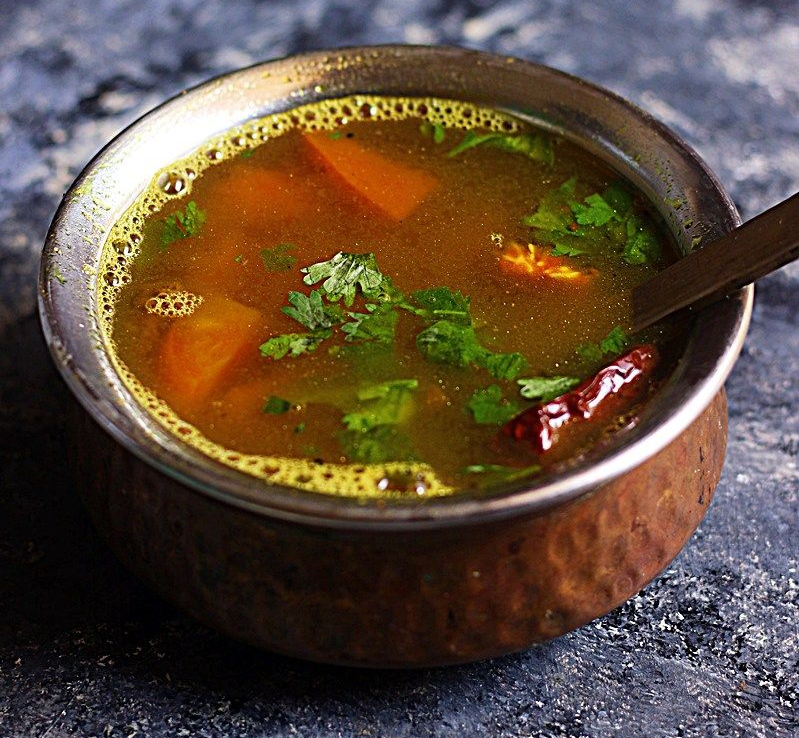
A lighter saaru might get much of its colour from turmeric, tomato and chilli, with the broth remaining relatively thin.
Sambar has a different base - cooked dal, vegetables and a more substantial spice blend - so the same turmeric and chilli can end up looking deeper and more opaque.
And then the actual ingredients matter.
One tomato might be pale and acidic.
Another might be deep red and ripe.
One batch of chilli powder may be more colour-forward.
Another may bring more heat.
Even the way you roast your spices changes what comes through.
Saaru | Sambar | |
Base | Thin, lighter broth | Dal + vegetables |
Colour | Often lighter/red-golden | Usually deeper/oranger |
What influences colour | Tomato, chilli, turmeric, spices | Spice blend, turmeric, chilli, vegetables |
Texture | Light | More substantial |
So there isn't really one "correct" red for saaru or one "correct" orange for sambar.
That's the part I love.

And this brings me back to Kai Guna.
My grandmother had hers. Lalita Atte has hers. My mother has hers.
And now, after growing up eating all of them, I have mine.
I don't think Kai Guna means one person's cooking is better. It means you can taste the person who cooked it. That's what I try to bring to Anvaya.
The food is Karnataka-inspired. The meal is vegetarian. The spice blends are made in my kitchen. The ghee is made at home.
And the colour on your plate?
Sometimes, it's simply the colour of the ingredients I cooked with.
At Anvaya
I serve a 13-course Karnataka-inspired vegetarian meal on a banana leaf, around one shared table. It's food rooted in the kitchens I grew up around in Bangalore - but cooked through my hands, in my kitchen at Mumbai.
Not perfect. Not identical every time.Just made with care, the way food should feel when someone has cooked it for you.
That's my Kai Guna.
That's the part no recipe can quite explain.


Comments